Loading…
Loading…
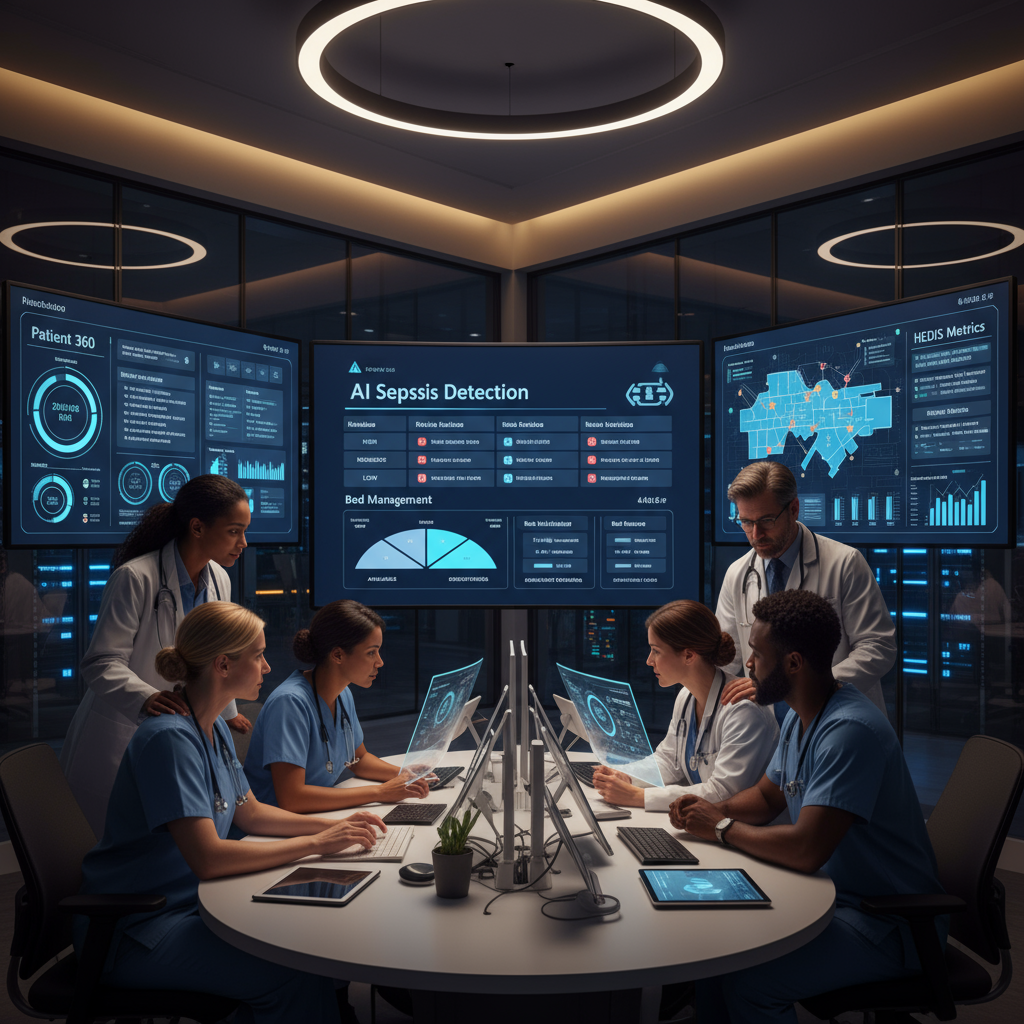
EHR/EMR integration with AI-powered clinical decision support and population health management
Industry
Healthcare
Timeline
8 months
Team Size
9 professionals
A major integrated healthcare network with 15 hospitals, 200+ clinics, and 2.3 million patients needed to transform patient care delivery by unifying fragmented clinical systems, implementing AI-powered clinical decision support, and transitioning to value-based care models with population health management and HEDIS quality measure tracking.
Patient clinical data siloed across 20+ disparate systems: EHR (Epic), lab information systems (LIS), picture archiving systems (PACS), pharmacy systems, and billing
Care teams unable to access longitudinal patient history in real-time at point of care
Reactive care model—clinical interventions only triggered after critical events occurred
Unable to predict patient deterioration, sepsis onset, or hospital readmission risk before traditional clinical alarm thresholds breached
Inefficient bed management and patient flow causing ED boarding and delayed admissions
Medication reconciliation challenges leading to adverse drug events (ADEs) and interactions
Lack of population health analytics preventing proactive chronic disease management
Complex HIPAA, HITECH compliance requirements creating data integration and privacy barriers
No visibility into social determinants of health (SDOH) impacting patient outcomes
Difficulty tracking HEDIS quality measures for value-based care contracts
Implemented HIPAA-compliant Databricks Lakehouse as unified healthcare data platform with comprehensive audit logging
Built real-time HL7 v2 and FHIR streaming data pipelines integrating Epic EHR, vital signs monitors, lab systems (LIS), imaging (PACS), and pharmacy data
Deployed clinical AI/ML models for early sepsis detection, patient deterioration prediction, hospital readmission risk scoring, and mortality prediction
Created comprehensive longitudinal patient 360 view with complete medical history, vitals, lab results, medications, care notes, and social determinants
Established real-time clinical decision support system delivering predictive risk scores and care recommendations to providers at point of care
Implemented intelligent bed management optimization using real-time census data, discharge predictions, and ED inflow forecasting
Built clinical surveillance dashboards for infection control, quality metrics, and patient safety monitoring
Architected comprehensive data governance framework ensuring HIPAA, HITECH compliance with role-based access controls and PHI de-identification
Integrated social determinants of health (SDOH) data including housing, food security, and transportation for holistic patient risk assessment
Created population health management platform with chronic disease registries, care gap identification, and HEDIS quality measure tracking
Achieved 22% reduction in preventable adverse patient events through AI-powered early detection and intervention
Improved clinical outcomes by 18% with evidence-based predictive care protocols and clinical decision support
Enabled early detection of patient clinical deterioration an average of 4 hours sooner preventing ICU transfers
Reduced 30-day hospital readmissions by 15% through discharge planning optimization and post-acute care coordination
Saved $4.5M annually through optimized bed utilization, reduced length of stay, and prevented complications
Decreased medication-related adverse events by 31% with real-time drug interaction checking and clinical alerts
Unified longitudinal clinical data for 2.3 million patients across entire integrated delivery network
Provided care teams with real-time patient risk scores and clinical insights embedded in EHR workflows
Achieved full HIPAA, HITECH compliance with comprehensive audit trails and PHI protection
Improved HEDIS quality measure performance by 23% supporting value-based care contract success
Reduced sepsis mortality by 19% through early detection and Surviving Sepsis Campaign protocol adherence
"BCTCGI didn't just build us a data platform—they helped us fundamentally transform how we deliver patient care. Our clinicians now have predictive insights that enable proactive interventions, and we're catching complications before they become crises. The impact on patient outcomes has been remarkable, and the lives saved speak for themselves."
Let’s connect to discover how our innovative ideas can help you solve your complex challenges.
Contact Us